
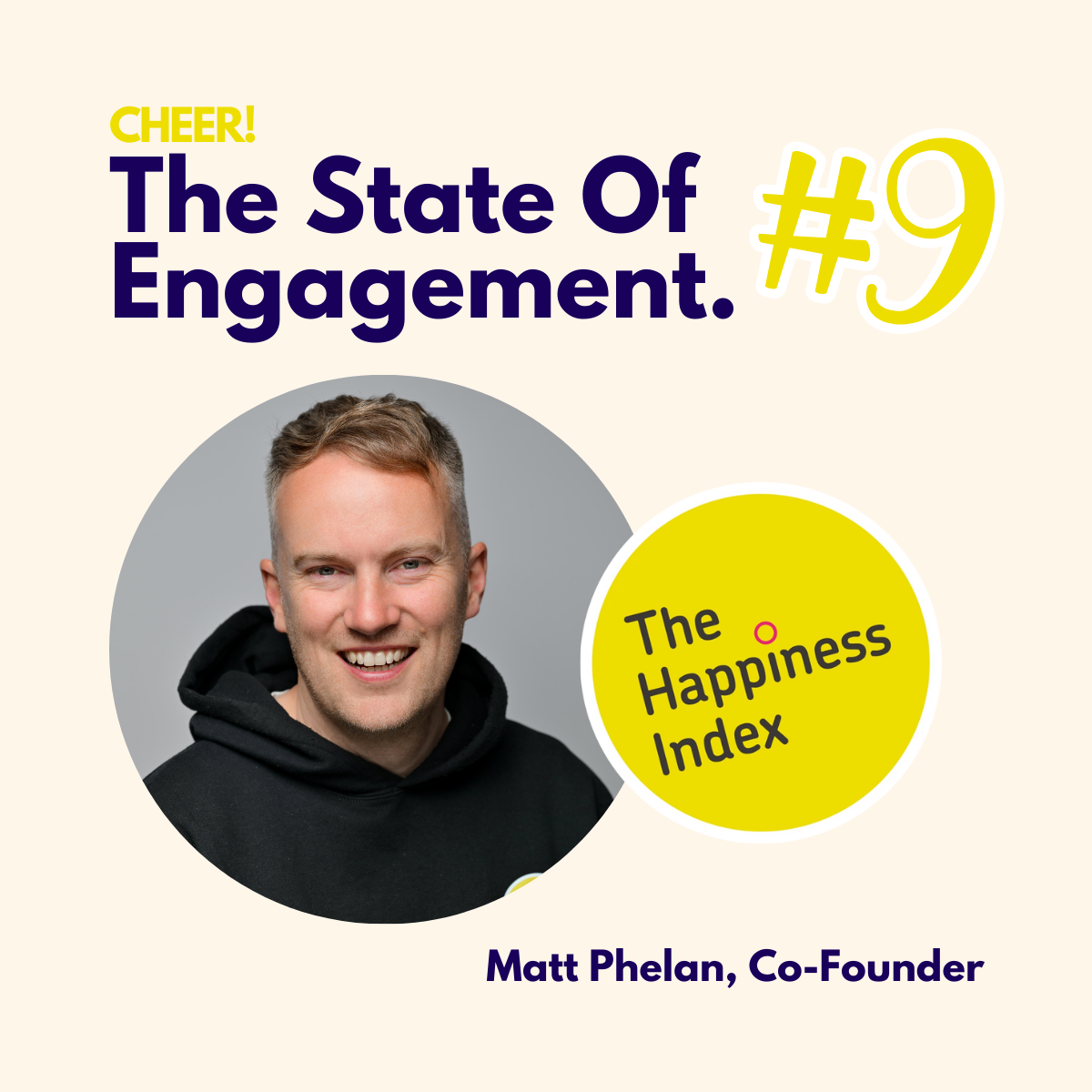
The State of Engagement:
Matt Phelan
Co-Founder, The Happiness Index
This edition of TSOE is with the AUTHORITY on happiness at work. Someone with 50+ million data points on workplace culture, who makes complex insights feel human.
If you work in People, Culture, or Engagement, you’ll already know the name Matt Phelan. He’s the Co-Founder of The Happiness Index – a platform measuring employee engagement and happiness through neuroscience, data, and real-time insight.
Matt’s mission is clear: understand what makes people happy at work and help leaders use that insight to build better organisations. He challenges companies to treat culture as seriously as they treat revenue.
Today’s edition digs into what really drives engagement, why transparency beats perfection, and why culture is still the operating system behind every EVP.
What engages employees?
Rather than his own view, Matt kindly shared data from The Happiness Index – where they found the top four drivers of engagement (how employees think about their work) as clear indicators of what truly motivates and ‘gets the most out’ of people:
- Clarity: Do employees understand their role, the expected outcomes, and how their work fits into the bigger picture? Ambiguity is a profound source of stress and disengagement.
- Meaning & Purpose: Does the work feel significant? When employees connect their daily tasks to the organisation’s mission, they shift from being task-doers to value-creators.
- Opportunities to Grow: This isn’t just about promotions; it’s about continuous learning, skill development, and feeling that one’s career is advancing. Data often proves that stagnation is a major catalyst for talented people to look elsewhere.
- Enablement to Succeed: Do employees have the right tools, resources, training, and processes to effectively do their jobs
I’ve always agreed with this – Leaders should be creating an environment for people to succeed, and be able to communicate effectively how their team can grow, and how they can connect with the organisation.
What gives your business the edge in attracting and retaining talent?
Matt kindly shared this response to summarise what The Happiness Index do:
- Practising What We Preach: We believe our primary edge comes from striving to practise what we preach. When a candidate sees that a company dedicated to workplace culture is actively measuring and acting upon its own culture data, it builds immediate credibility.We don’t always get it right but we are always working hard to apply what we learn in our work.
- Transparency over Perfection: We are fundamentally against the notion of Toxic Positivity. We don’t pretend to be perfect; instead, we are transparent about where we need to improve. Psychological safety is built not when everything is flawless, but when the leadership is brave enough to address flaws openly.
- Data as a Recruitment Tool: We treat our culture data as a source of truth, not a secret. If a candidate asks, we will share data on our culture during the interview process.
- Attraction to Vision and Impact: Ultimately, we attract employees who are passionate about the future. Individuals who want to make a difference in the future world of work are naturally drawn to our vision, as they see a clear path to impact how millions of people experience work globally.
In your experience, what are employees looking for?
“The critical summary here is human beings are not looking for one single thing”, says Matt.
“They are looking for the conditions to experience both Engagement (Clarity, Purpose, Growth, Enablement) and Happiness (Relationships, Safety, Freedom, Acknowledgement). Leaders must manage and measure for this vital combination if they truly want a thriving, high-performing culture.”
Again, this isn’t just Matt’s opinion, he’s repeatedly seen four pillars rise to the top. Relationships, Safety, Freedom (Autonomy), and Acknowledgement.
Which part of EVP matters most to you personally?
EVP, or Employee Value Proposition, is the balance of what people give and what they get back. I like to break it down into seven pillars:
Brand & Purpose, Culture, Environment, Monetary, Prospects, Relationships, and Wellbeing.
Although Matt recognised that the answer is almost certainly context-dependent, I pushed to understand his own perspective. He chose one that he believe acts as the foundation for all of the others – Culture.
“Culture is the invisible operating system. It dictates how Relationships function, how seriously Wellbeing is taken, and whether Brand & Purpose is authentic or just a slogan. While Monetary rewards are a very important hygiene factor, a toxic culture will negate even the most generous compensation package, a fact that countless anecdotal and formal studies confirm.”
What are your biggest people challenges right now?
Matt did say transparency over perfection – and was transparent in outlining their challenge.. their ambitious challenge.
” Delivering the today and our current work, whilst simultaneously
working towards our new mission to deliver 1 billion data points on workplace happiness globally.”
What this means from a people perspective was clear, as was their view on solving this challenge.
Matt said “it means we are constantly focusing on ensuring our team has the dedicated capacity and, crucially, the time for their essential day work while also carving out sufficient space to develop the skills needed for our future work.
We approach this actively by conducting regular work audits using the Stop, Start, and Continue model for all employees. This helps us ensure that time is spent on high-value, high-impact tasks and that we are enabling our team to succeed by removing blockers. Once again we are not perfect at this and it is all a work in progress!”
But what progress they’re making, indeed!
Final Thoughts
Matt left me with a recommendation:
“If I had one recommendation for anyone reading this, it would be simple: Ask your team what makes them happy and explore what makes your team members happy and engaged.”
I’m so glad he said that – it’s one of the most simple and straightforward ways I’ve seen to engage with teams.
The future of engagement belongs to organisations that listen continuously, act transparently, and treat happiness as a measurable, essential part of performance, rather than a “nice to have”. Matt’s data backs it.
Find out more about The Happiness Index
Book Matt Phelan as a speaker or follow Matt on Linkedin
Contact CHEER!
Click here for past editions of The State of Engagement