
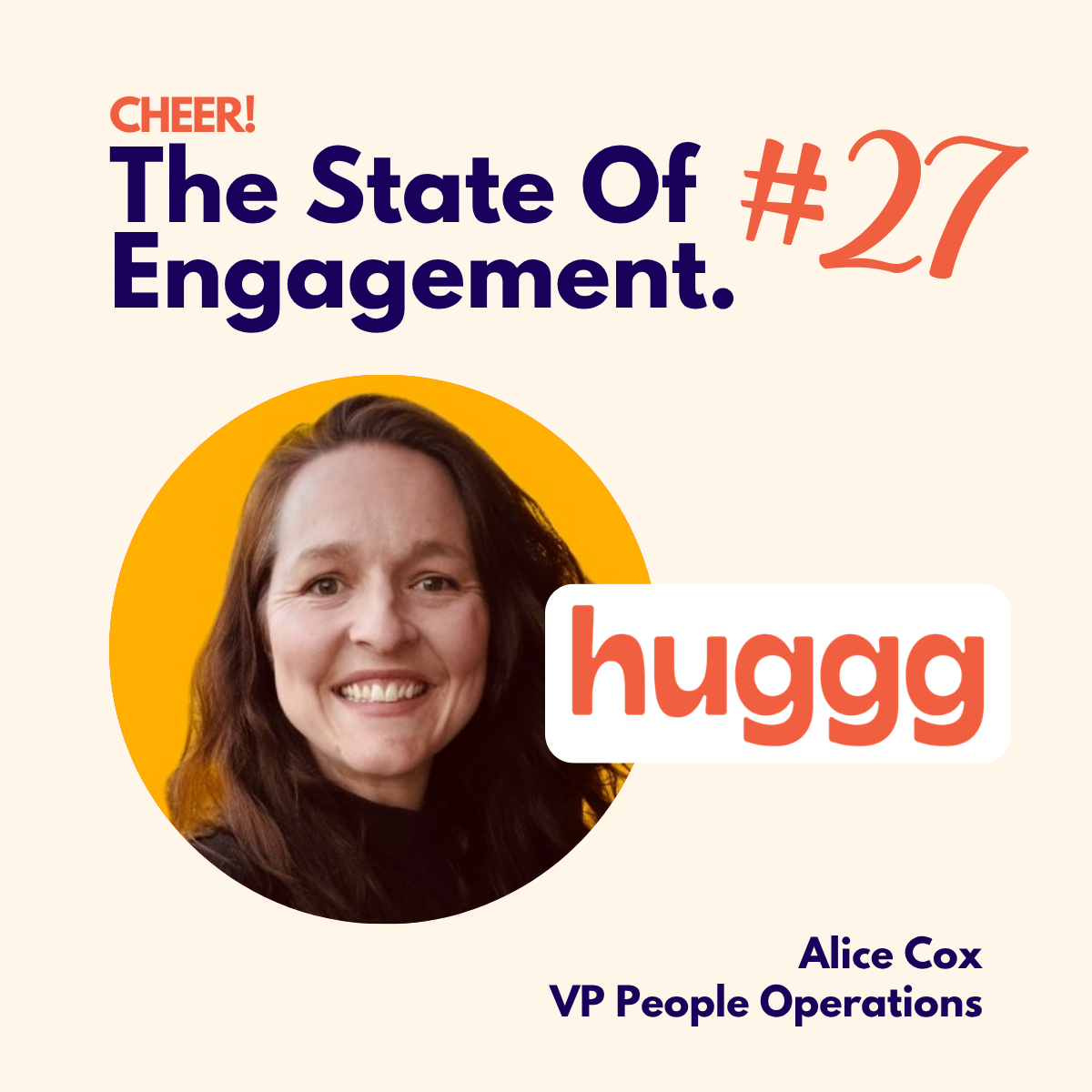
The State of Engagement:
Alice Cox, Huggg
How do you manage employee engagement in a fully remote organisation?
This edition of The State of Engagement is with Alice Cox, VP of People Operations and employee number one at Huggg. She has seen the business grow from a single desk into a company used by more than 2,000 UK businesses.
Huggg makes gifting easy, for in-the-moment recognition. Businesses can send employees a gift in minutes, with recipients choosing what suits them from thousands of options across 700+ brands.
But recognition is clearly about more than what Huggg sells. As a fully remote company, Alice and the team have had to be deliberate about how they create connection, recognise contribution and maintain a sense of being one team.
What engages employees?
“Honestly, engagement is one of the biggest challenges of being fully remote, so we’re deliberate about it”, says Alice. “We get the full team together face to face every two months, and everyone attends unless something genuinely unavoidable comes up.
The other thing that works is noticing what people add. Sometimes that’s a manager, often it’s a teammate. We have a team appreciation wallet so anyone, in any department, can gift anyone else, whether they’ve earned it or just need it. People loved it so much we recently doubled the budget.
It’s all about little and often. Grand gestures happen once a year. Small, ad-hoc, in-the-moment recognition builds up, and the result is a more engaged team.”
What do you believe gives Huggg the edge in attracting talent?
Huggg put decent perks and solid policies in place early, before they were big enough to need them. “Most small companies stay reactive until something goes wrong, then write the policy. Getting it right early meant we never had to retrofit a culture.”
You don’t need a big HR department to do create your culture. Alice was employee number one, sat on her own at a desk. She’d come from a large outsourcing company, so wrote a handbook full of policies early on – a lot of this remains today.
“Beyond that, being small and fast-paced with minimal red tape is genuinely appealing. We’re very intentional about hiring: ads out to lots of varied outlets, a serious interview process, and a probation period we actually use. We also read cold CVs. Some of our longest-serving people emailed in on spec and have been here six or seven years.”
In your experience, what are employees looking for most?
Alice states flexibility, and to be trusted with it, as key. “Part-time and compressed hours are normal now, and people are still working extremely hard around everything else they’re juggling. The companies that get this right stop treating reduced hours as reduced commitment.
The most valued things here are remote working and the option to work abroad temporarily, which matters enormously if you have family overseas or want to travel without burning your annual leave. We also run a learning and development budget and a health and wellbeing one.”
You’d hope for a gifting company they get reward right, and you’d be right – but it wasn’t from day one. “We once asked what people wanted, built exactly that, and watched nobody use it. Frustrating, but it taught us that asking once isn’t enough. Now we ask regularly and keep things flexible and inclusive, so people take what actually suits their life. Nobody wants to look at a list of perks that don’t apply to them.”
Which part of EVP matters most to you personally?
EVP, or Employee Value Proposition, is the balance of what people give and what they get back. I like to break it down into seven pillars:
Brand & Purpose, Culture, Environment, Monetary, Prospects, Relationships, and Wellbeing.
This was a difficult one for Alice to answer, because they take all seven seriously, but as pushed, she lead with culture and wellbeing right behind it.
“Monetary reward is the pillar you’d expect me to pick, given what we sell. We do pay market rate, and we’d rather pay fewer people well than have more people on lower salaries. But pay isn’t why people stay. We have very few resignations, and when I look at why, it’s culture, wellbeing, and people believing in what we’re doing.
Reward is the visible expression of all that. A £30 gift from a manager who knows what you’ve been carrying means something. The same gift from someone who hasn’t spoken to you in six weeks is a transaction.”
What do you see are the biggest people challenges Huggg is facing right now?
After ten years in, attracting talent isn’t a challenge, but cohesion, as a remote workforce, can be.
“We’re remote nearly all of the time and only together as a full group every two months”, she explains. “We arrived at that after trying quarterly, biannually and monthly, and two months is about right. But it means the day itself carries a lot of weight, and we’re still working at getting it right.
The wider version of that is keeping everyone coming back to the same core focus and feeling like one team. It’s harder remotely. Not impossible, but it doesn’t happen by accident.”
There’s a nice irony to speaking to Huggg about employee engagement. A company built around helping people feel seen has taken that same principle into its own culture.
Alice’s approach is refreshingly practical. Recognition doesn’t need to be a grand gesture, and it doesn’t always need to come from a manager. Sometimes it’s a teammate noticing what someone has added and saying thank you.
The same applies to flexibility. It only works when people are trusted with it, and Alice’s experience suggests that asking people what they actually value matters far more than creating an impressive-looking list of benefits.
Perhaps the biggest challenge for Huggg is one that many remote businesses will recognise: cohesion doesn’t happen by accident. It’s great to see a business not just recognising their challenges, but doing the work to overcome them.
Connect with Alice on Linkedin
Visit Huggg
Contact CHEER!
Click here for past editions of The State of Engagement
Want to improve engagement in your own organisation? Find out how our employee engagement consulting can help.