
The State of Engagement: Jenny Guo, Lanura
This edition’s guest left investment banking with a vision to make learning part of the flow of work – adaptive, personalised and built around how people actually behave.
Jenny Guo founded Lanura, that blends AI and behavioural science to help teams perform better when it matters most. Through realistic workplace simulations, employees practise high-stakes conversations, get personalised coaching and build the behaviours that drive business performance.
Our founder, Joe Morrison, was really interested in how she is addressing the threat of AI on human interaction by identifying how AI can actually improve human interactions – the links with employee engagement made this a fantastic conversation.
What engages employees?
For Jenny, employee engagement comes from giving people enough structure to succeed, but also enough freedom to experiment, make mistakes and learn from them.
“Trust is a big part of that”, she explains, “you need to trust people to do what they do best without micromanaging every step.
I recently met a lady called Rona Lewis, who does a lot of work around playful design and bringing play into the workplace. There’s quite a bit of neuroscience behind why play can drive engagement.
We spend so much of childhood learning through play, experimenting, imagining and trying things out. Then somehow, as adults, especially in the corporate world, we lose most of that. I think that is a shame. Play helps shift work from feeling purely transactional into something more energising.”
Jenny doesn’t mean the forced, awkward team activities that everyone secretly dreads. It can be small moments of real team bonding or giving people permission to try something in a low-risk environment.
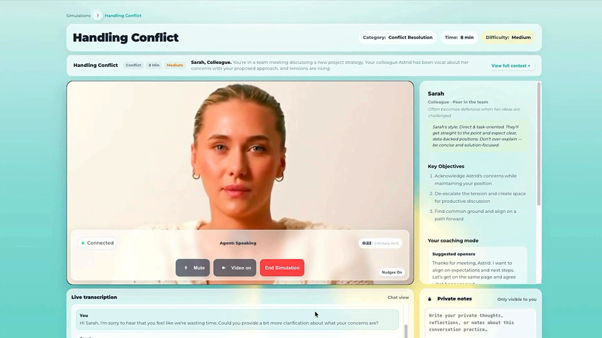
^An example of Lanura’s simulation in action
What gives businesses the edge in attracting and retaining talent?
For Jenny it’s the team, the vision and creating an environment where people can bring the most authentic version of themselves to work.
“Let’s be honest, as an early-stage startup, people are not joining Lanura purely for the money (we can’t yet compete with the 6-figures salaries of big tech!). So a lot of it comes down to the founding team.
A fun fact is that I met my CTO at a startup house party. We naturally clicked because we both had a real passion for building and creating new things. When I later came up with the idea for Lanura, he believed in me – my drive, my work ethic and my ability to execute.”
More than that, he believed in (Jenny’s words) the slightly crazy vision: to build a future where learning adapts to your behaviour, is contextual and is embedded into daily routines and workflows.
“I think you need that kind of strong vision (perhaps some call it delusional) for someone to leave a comfortable job and join you on the mad journey.”
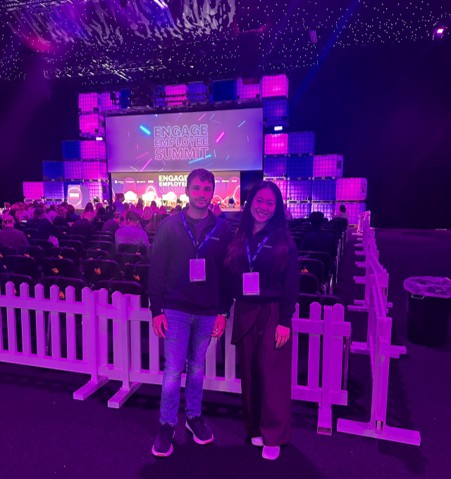
^ Jenny & Shawak (CTO) at their first conference exhibition
You spoke about Authenticity?
“ So many of us have a ‘work persona’, where we put on a mask and perform a version of ourselves.
Obviously, I’m not saying you should act exactly the same at work as you do with your family, but I do think people should feel they can lean more towards their authentic self rather than constantly performing a false version of themselves. Because frankly, it’s exhausting.
The more energy people spend pretending, the less energy they have for actual meaningful work.
In your experience, what are employees looking for?
Jenny believes that people are looking for three main things: clear opportunities to progress, making a meaningful impact and recognition. Financial rewards are obviously important, but according to Jenny there is a point of diminishing returns, where another pay rise does not make up for a lack of purpose or growth.
This echoes what Alex Hunt said in the previous edition and what I’ve always said – it’s not all about the money!
Which part of EVP matters most to you personally?
EVP, or Employee Value Proposition, is the balance of what people give and what they get back. I like to break it down into seven pillars:
Brand & Purpose, Culture, Environment, Monetary, Prospects, Relationships, and Wellbeing.
For Jenny – it’s simple, Culture. But she doesn’t mean culture in the superficial sense, where you stick a few values on a website, add a mission statement and call it a day.
“For me, culture is a mix of psychological safety and actually putting values into action, especially from the top down.
It’s easy to say you value openness, trust and ownership. It’s much harder to live those values when things are going wrong or when people disagree.
There’s a quote I really like: ‘Culture is what you do, not what you say.’ “
What do you see are the biggest people challenges businesses are facing right now?
“One of the biggest challenges businesses are facing right now is helping employees adapt to constant change.”
Whether it’s AI, new ways of working or shifting business priorities, people are being asked to learn faster than ever before. The challenge isn’t the technology itself – it’s helping people build the confidence and skills to keep up with it.
Jenny continued, “at the same time, many organisations are grappling with interesting generational shifts happening. Chuck in hybrid work into the mix and it becomes a lot harder to build culture and learn informally from one another as we used to.”
Jenny also worries that as AI becomes more capable, some of the human skills that matter most risk being neglected. Ironically, those are the very skills that will become more valuable in an AI-driven world.
For Jenny, the biggest challenge will be finding the right balance between human and AI – using technology to support people, without losing the human touch that work still needs.
Connect with Jenny on Linkedin
Visit the Lanura website
Contact CHEER!
Click here for past editions of The State of Engagement