
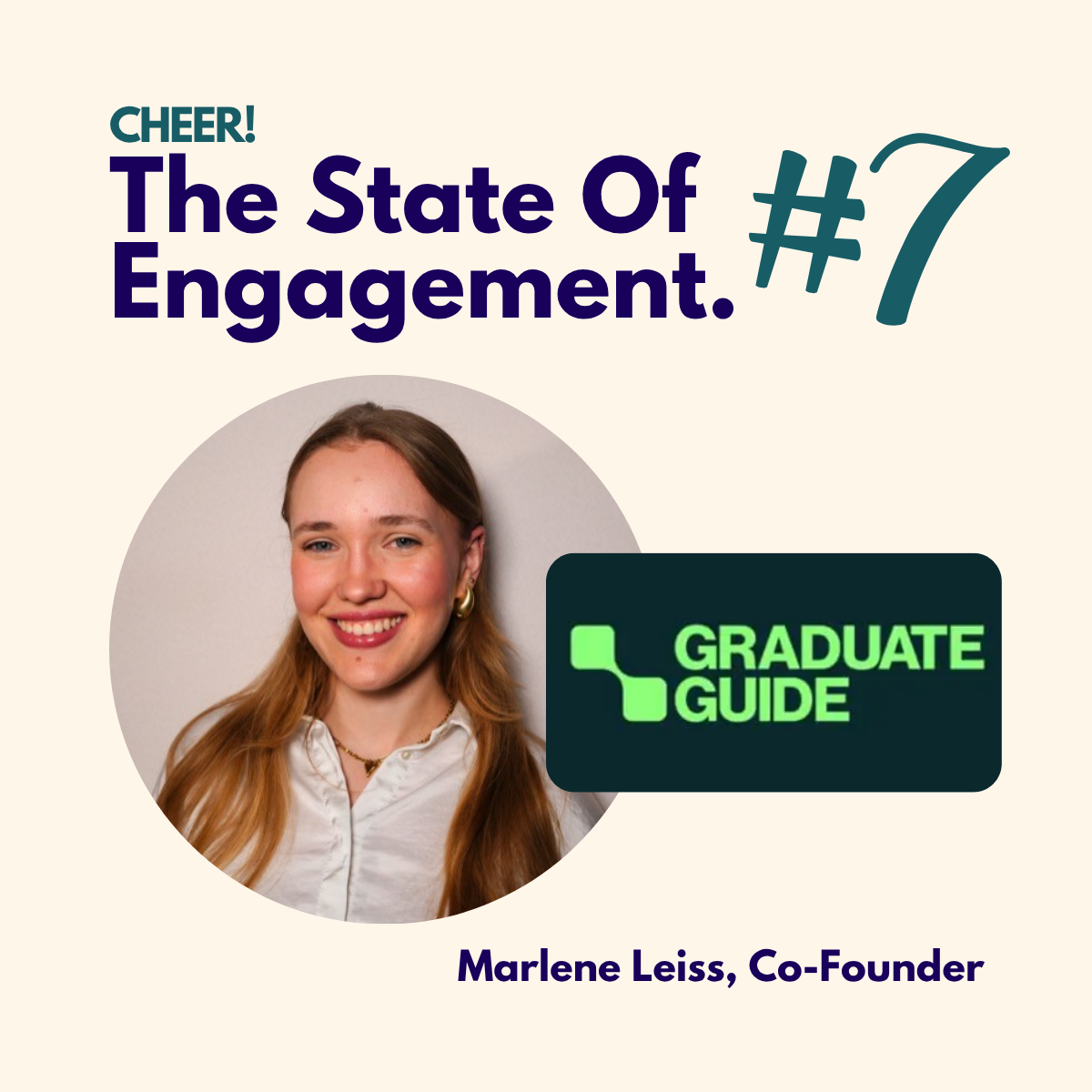
The State of Engagement:
Marlene Leiss
Co-Founder, The Graduate Guide
This edition of TSOE explores the future of engagement through the lens of emerging talent.
Marlene Leiss is the co-founder of The Graduate Guide, a community and platform helping graduates and early-career talent bridge the gap between education and employment.
The Graduate Guide supports young people through mentoring, training, and employability programmes – giving them the skills and confidence to succeed in a fast-changing job market.
What engages young people most today?
For Marlene, the answer starts with human connection.
Despite assumptions that Gen Z wants to work remotely, she says the opposite is increasingly true.
“Purely remote cultures don’t work for young people. So much learning happens informally – overhearing conversations, grabbing coffee with a colleague, observing how a manager works. Those moments build belonging.”
She highlights how many graduates now crave in-person collaboration, mentorship, and visibility over flexibility. “People want to go somewhere, meet people, learn from them,” she says. “Flexibility is still valued, but for early-career talent, community matters more.”
What gives organisations the edge attracting young talent?
Communication.
Marlene believes employers often underestimate how clearly they need to explain what’s in it for the employee.
“It’s not enough to talk about your mission anymore. Every company has one. Young people want to know: what am I learning here? Where does this role take me? What happens after two years?”
Start-ups used to lead with purpose alone, but as every organisation now claims to “change the world”, mission talk alone doesn’t differentiate. Those that win talent are the ones that show clear pathways for learning and progression from the first conversation.
We completely agree with Marlene on this one – This is why at CHEER we use EVP to help employers understand what’s important to their employees.
In your experience, what are employees looking for?
Young professionals are more deliberate than ever. They expect transparency, direction, and development, but they also seek relationships and meaning.
Marlene also recognises the misconception of GenZ as the future of work. “Our generation isn’t lazy or entitled; we just think critically about why we join a company,” says Marlene.
“We want to grow, learn, and connect – not just clock in.”
She adds that the narrative around Gen Z being disengaged is misplaced. “Actually, they want to work and meet great people. They’re just quicker to leave when things feel misaligned.”
Which part of EVP matters most to you personally?
EVP, or Employee Value Proposition, is the balance of what people give and what they get back. I like to break it down into seven pillars:
Brand & Purpose, Culture, Environment, Monetary, Prospects, Relationships, and Wellbeing.
So what is the most important to Marlene?
For Marlene, it’s a triangle of balance: “Money, Relationships, and Learning. You need at least two for a job to make sense. Ideally three.”
If a role delivers only one, it quickly feels hollow. She says this simple model helps both employers and employees clarify what really drives fulfilment.
And while London’s cost of living pushes many to chase salary, Marlene notes that it also shifts priorities: “If financial goals like home ownership feel out of reach, people want their work to matter more.”
What are the biggest people challenges right now?
The broken promise between education and employment.
“Young people were told there’s a clear path – go to university, get a job, everything follows. But the market’s changed. Companies are hiring less, experimenting with AI, and often unsure themselves what the future looks like.”
She’s critical of how education still operates like an industrial production line. “We’re not teaching the skills that actually get you hired – communication, curiosity, confidence.”
The Grad Guide tackles this through mentorship and training that build soft skills as much as technical ones. “Everyone’s talking about AI, but it’s EQ that lands the job,” she says.
Marlene also warns about the emerging “diamond-shaped workforce”: which is fewer entry-level roles, a bulge of mid-management, and fewer leaders at the top. “It’s risky,” she explains. “If companies stop bringing in young talent, who will step up in ten years?”
Final thoughts
Purpose alone is of course still important, but it’s not enough to engage. Transparency, opportunity, and human connection do so much more.
“Our generation may not have everything figured out, but we know what resonates. We want to belong somewhere that feels meaningful.”
The Graduate Guide’s mission captures that sentiment perfectly: helping young people find their place, learn from others, and grow into work that matters.
Find out more about The Graduate Guide
Follow Marlene on Linkedin
Contact CHEER!
Click here for past editions of The State of Engagement